Have You Ever Been Ghosted?
The candidate ghosting problem—and how AI can help recruiters close the communication gap without automating away the human relationship.
You interviewed for the job. The conversation went well. The recruiter said the team would be in touch soon.
And then? Nothing.
No update. No rejection. No explanation. For candidates, this experience has become frustratingly familiar.
Ghosting is not simply an uncomfortable moment in the recruiting process. It is a workflow problem.
Watch: why candidate communication breaks down—and how GhosterBuster helps recruiting teams follow up consistently.
Recruiters are not usually trying to ghost candidates.
I have spent more than a decade working in recruiting, and I do not believe most recruiters wake up and decide they are going to ignore candidates.
Recruiting teams are managing hiring managers, interviews, scheduling, candidate pipelines, offer processes, sourcing, ATS updates, internal meetings, and sometimes thousands of applicants.
AI has added another dynamic. It is easier than ever for candidates to discover and apply to roles at scale. Greenhouse reported that 38% of job seekers were mass applying, while recruiter workload increased 26% in a single quarter.
The result can be a communication breakdown. A recruiter intends to follow up. Another meeting happens. A hiring manager has not provided feedback. The role gets put on hold. Three days become seven. Seven become fourteen.
We can use AI differently.
Much of the conversation about AI in recruiting focuses on speed: sourcing faster, screening more resumes, processing more applications, and saving recruiter time.
Those are valid questions. But there is another question we should be asking:
Can AI help us create a better experience for candidates?
I believe it can. AI can help recruiters identify candidates waiting for updates, organize follow-up queues, draft personalized communications, summarize hiring-manager feedback, and surface conversations that have gone quiet.
The recruiter still owns the relationship. AI simply helps make sure the relationship does not disappear underneath the workload.
Automation does not have to mean impersonal.
There is an important distinction between automating communication and automating relationships.
Candidates do not necessarily need a recruiter to personally write every administrative message from scratch. They need to know what is happening.
That takes seconds to review and send when technology helps surface who needs an update.
Technology can handle the reminder. AI can help draft the message. The human recruiter remains responsible for the relationship.
Candidate experience has long-term value.
Closing the loop is not only about being polite. Candidates remember how companies treat them.
Greenhouse found that 79% of candidates would consider reapplying if they received feedback after interviewing but were not ultimately hired.
Today’s rejected candidate could be tomorrow’s perfect candidate, a future customer, a referral source, a future employee, or someone who recommends—or discourages—others from applying.
Candidate communication is part of employer brand.
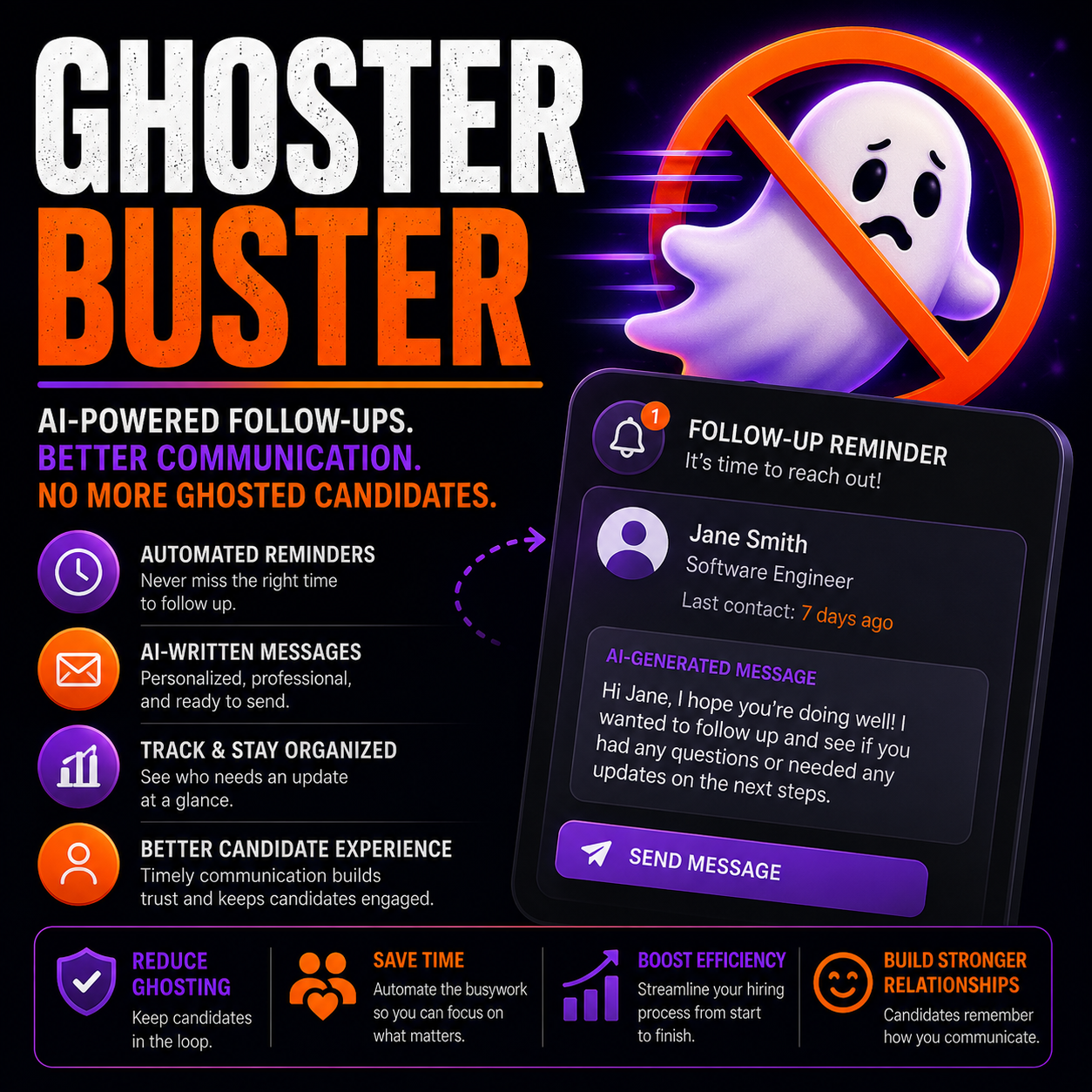
That is why I built GhosterBuster.
I started building AI recruiting tools around a simple idea:
AI should not only help companies process candidates. It should help companies treat candidates better.
GhosterBuster is designed to help recruiting teams identify candidates who need communication and make follow-up easier before someone falls through the cracks.
The goal is not to replace recruiters. It is to remove one of the easiest ways for a good candidate experience to become a bad one: silence.
Because candidates should not need to wonder whether they are still being considered—and recruiters should not have to rely entirely on memory to make sure every candidate gets an answer.
See GhosterBuster in action.
Explore the recruiting workflow or talk with Rocky Phoenix AI about creating more consistent candidate communication.
Explore GhosterBuster Book a conversationSources
Greenhouse — 2024 State of Job Hunting Report and 2024 Candidate Experience Report
Criteria — 2024 Candidate Experience Report
CareerPlug — 2024 Candidate Experience Report